The "Context Hygiene" Problem: Why I Rewrote My Claude Code Workflows
I wasn't procrastinating, I swear.
Instead of finishing my actual projects this weekend, I got engrossed in rebuilding my tooling.
I just released Flow. It's a Claude Code plugin that streamlines the development lifecycle. It stands on the shoulders of giants, fully integrating with both RepoPrompt and optionally Steve Yegge's Beads.
The Motivation: 40k Tokens of Waste
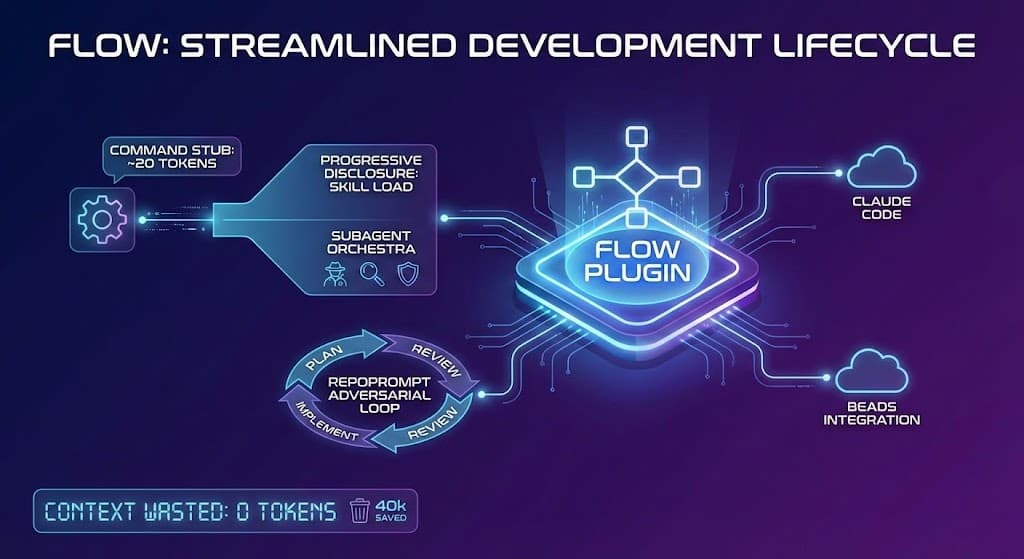
I realized I was losing around 40k tokens of my context window on startup. It was polluted by loaded MCPs, plugins, and massive command definitions I rarely touched.
I also got tired of the manual friction involved in sending plans and implementations out for architectural review. I do not believe in complex agent workflows. I want a disciplined, deterministic loop:
Plan → Review → Implement → Review.
The Pattern: Command Stubs & Progressive Disclosure
I rewrote the workflow using a Command Stub → Skill pattern. I have not seen this used elsewhere yet, but it works incredibly well.
- The Stub: A tiny ~20 token definition that sits in the context window.
- The Skill: The heavy logic only loads when triggered.
This gives you the best of both worlds:
- Progressive Disclosure: keeping the context clean
- Dual Triggering: trigger via natural language ("Help me plan X") OR explicit slash command (
/flow:plan)
The Subagent Orchestra
The real power is in the coordination. The plugin orchestrates 6 specialized subagents that run in parallel phases.
1. The Scouts (Context Gathering)
The agent intelligently chooses the right tool for the job:
- context-scout: If
rp-cliis detected, it uses the RepoPrompt builder to map architecture and function signatures. Slow, deep, and context-aware. - repo-scout: If not, it falls back to fast grep/glob operations to find existing patterns. Cheap and fast.
2. The Researchers
- practice-scout: Researches community best practices for the specific task at hand.
- docs-scout: Fetches relevant official documentation to ensure we're not hallucinating APIs.
3. The Analyst
- gap-analyst: This is critical. It takes the drafted plan and explicitly hunts for missing user flows, unhandled edge cases, and logical gaps before the plan goes to review.
The "John Carmack" Adversarial Loops
I married the workflow with RepoPrompt to create an adversarial review loop. If the plugin detects rp-cli, it automatically delegates reviews to a separate model (e.g., GPT-5.2 High).
It's not a single pass. It's a fix-until-pass loop. This applies to both core workflows:
The Planning Workflow (/flow:plan)
The agent scouts, researches, drafts a plan, and submits it to RepoPrompt. It implements fixes and re-submits until the reviewer is satisfied.
The Implementation Workflow (/flow:work)
The agent executes the plan and writes tests. It grabs the git diff, builds context, and submits it for a correctness/security check. It fixes the code and re-submits.
Beads Integration
If it sees a .beads folder, it automatically adapts. It creates Epics and Tasks instead of Markdown files, tracking dependencies natively.
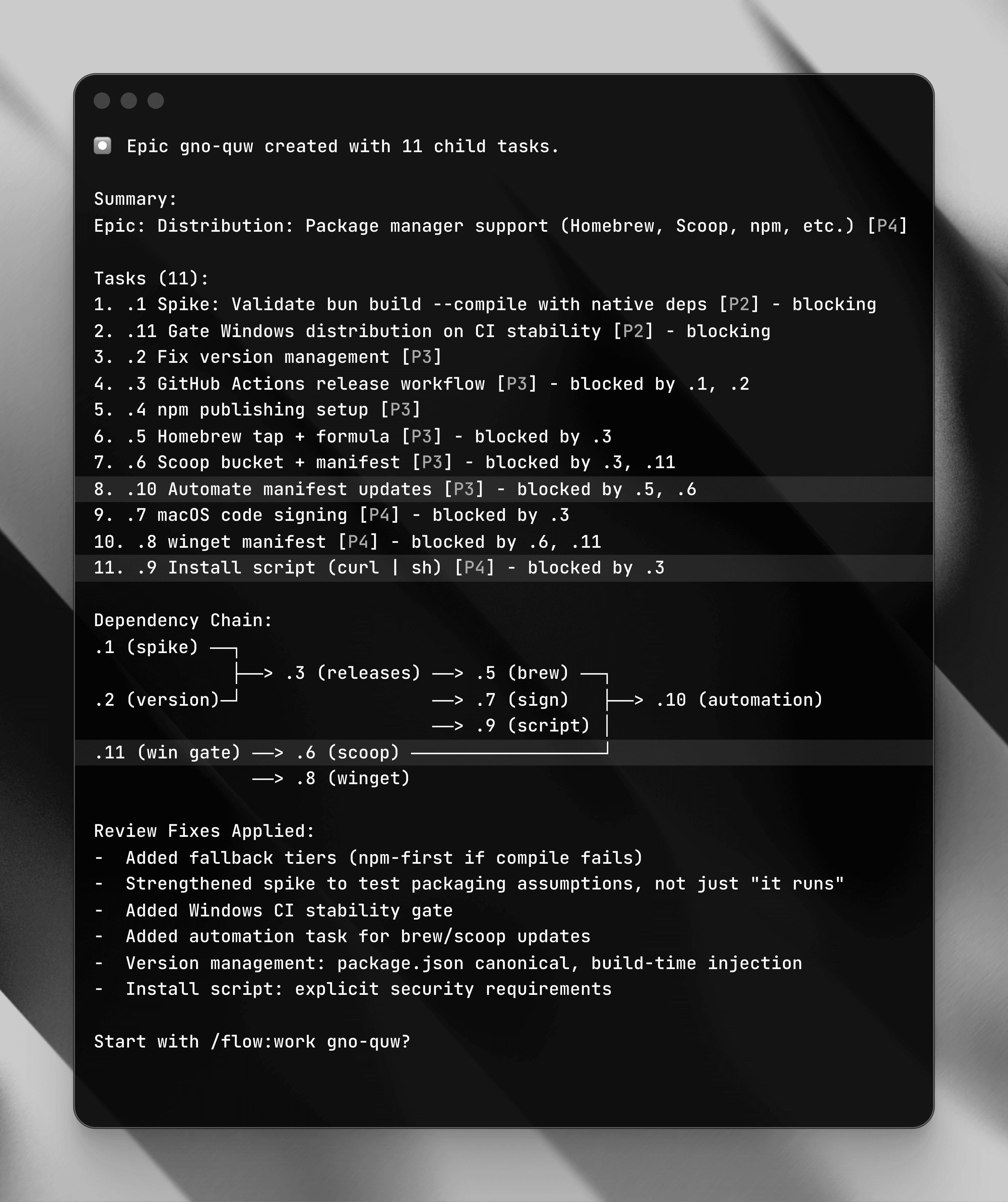
The Result
This is not just "chatting with code." It's an enforced, disciplined engineering process that happens to be executed by agents.
Links:
Give it a try or help me improve it; I've received great feedback so far.